

This practice is done in writing, by hand, in a calm environment. For a deeper immersion, choose a красивый notebook or a decorative sheet of paper and your favorite pen. Before you begin, close your eyes for a minute and notice your current state — how you feel physically and emotionally. Then briefly write it down to mark your starting point.
Creating a new life script includes several stages:
1. Current Script
Describe your current life in detail, exactly as it is now — as honestly as possible, without trying to embellish it. Include not only external circumstances, but also recurring behavior patterns: how you make decisions, what actions you postpone, where you avoid, how you react to stress, what emotions you experience most often, and what results this leads to. It’s important to capture repeating patterns rather than isolated cases.
Write in the first person, in the present tense, as if you are a screenwriter describing a film that has already been made.
2. Breaking Point
Identify the point where you refuse the old script by answering in writing why you are no longer willing to live this way and what price you are paying to maintain your current patterns — specifically, what you are losing in terms of money, energy, opportunities, time, relationships, and your inner state.
This step helps create inner clarity and removes the illusion that everything is fine as it is.
3. New Script
Move on to shaping your new script. Describe your life as if the changes have already happened and become your norm. Write in the first person, in the present tense, without using phrases like “I want” or “I will.” Be specific — not abstract “things are good,” but how you now act in situations that used to be difficult, what choices you make, how you set boundaries, how you manage your time and resources, and what actions you take regularly.
Pay special attention to how your reactions change in stressful or triggering situations — this is where real transformation shows. Also describe your internal state through specific sensations: your level of calmness, stability, focus, and confidence.
Try to write not an “ideal life,” but a different behavioral model.
4. Rewiring Through Choice
Now the key part. Define the transition from the old to the new through specific links. For several typical situations that repeat in your life, write how you used to act and what new action you choose now.
Create at least 5–7 such links. The new behavior should be realistic and achievable, not perfect. This creates a direct bridge between awareness and actual change.
5. Energetic Anchoring
Place your hand on your chest or stomach and read your new script out loud. While reading, focus on bodily sensations and notice the state that arises, as if this were already your reality.
There’s no need to force emotions — simply observe and hold your attention on the feeling that appears for 1–2 minutes. This connects the text not only to logic, but also to your internal state.
6. Entry Point into Reality
To finish, choose one specific action you will take within the next 24 hours in alignment with your new script. It should be simple, doable, and directly related to the changes you described. It should require minimal resistance while confirming your new way of acting. Write it down and complete it within the set time.
🌟🌷🌟
Regular repetition of this practice gives your mind a clear direction. By refining the script and consistently moving into action, you gradually reinforce new patterns and reduce the tendency to fall back into old automatic reactions.
A short reminder for your practice ⬇️⬇️⬇️
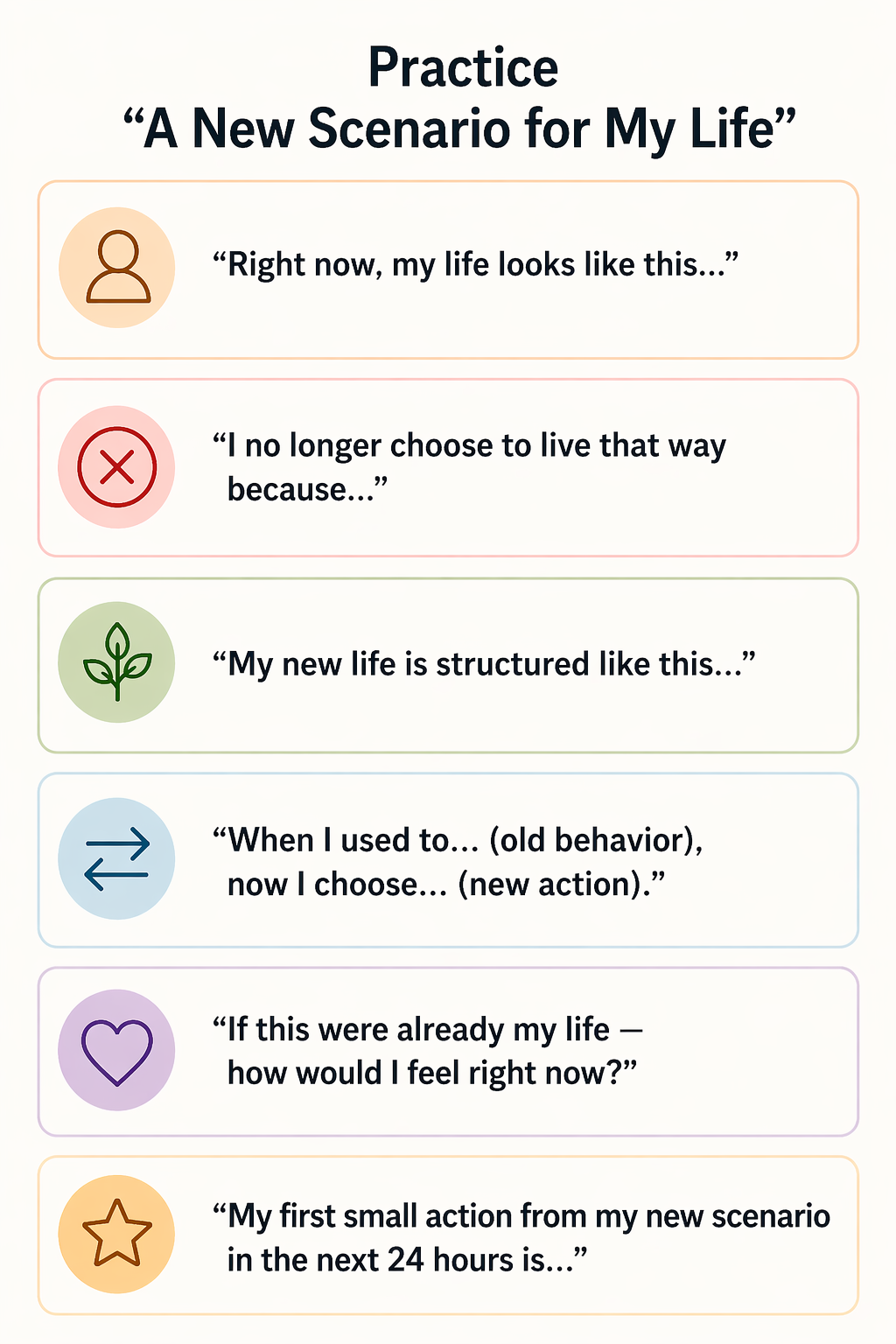
© Elena Shuwany






No comments!
There are no comments yet, but you can be first to comment this article.